At the “Trust Forum” hosted by sproof and PricewaterhouseCoopers (PwC) at Vienna’s DC Tower, experts from Erste Bank, Raiffeisen, A-Trust, PwC, and sproof discussed the operational roadmap for the European Digital Identity (EUDI) Wallet. The key takeaway: The legal deadlines set for the end of 2027 require strategic architectural decisions to be made now—but they also open the door to measurable efficiency gains for companies.
Starting at the end of 2027, the European Union will require regulated industries to accept the EUDI wallet. What this transition means for banks, critical infrastructure, and small and medium-sized enterprises was the focus of the “Trust Forum” in Vienna. In a video message, Austrian State Secretary for Digital Affairs Alexander Pröll emphasized the urgency of the matter: “By the end of 2027 at the latest, banks, telecommunications companies, energy providers, and many others must accept the EUDI Wallet. Those who start preparing now will have a real advantage.” At the same time, he praised sproof’s pioneering role as an example of Austrian innovation on a European scale.
“The Trust Forum bridges the gap between regulatory requirements and operational IT security. We bring together key stakeholders to collaboratively put reliable standards for European data sovereignty into practice.”—Dr. Fabian Knirsch, Co-Founder and CEO, sproof
Portable Proof, Lasting Responsibility
Valeria Garofalo, Valeria Stefani, and Ali Raza Syed from PwC Austria highlighted the strategic decisions companies must make by December 2027 in their keynote address, “From ID Austria to EUDI Wallet.” Their key message: The transition from a single national system like ID Austria to a European ecosystem with numerous issuers, credentials, and member states requires far more than just a technical software update.
While digital proofs will become portable across national borders in the future, the regulatory responsibility for verification and liability remains entirely with the accepting companies. A cryptographically authentic proof of identity does not automatically satisfy all due diligence requirements—such as those regarding the source of funds or current residence in the context of anti-money laundering (KYC). Furthermore, for audit compliance purposes, it is not sufficient to simply extract master data from the wallet; businesses must also document the cryptographic verification proof, including the timestamp and the applicable rules.
To ensure that the implementation—covering login, onboarding, and account recovery—delivers genuine efficiency, PwC Austria has identified three critical decisions that must be made by December 2027:
- Credential Verification: Which digital credentials from which issuers does the company accept?
- Trust Policy: Which internal set of rules specifies for which business processes a particular credential is sufficient?
- Enterprise Orchestration: Where do technical verification, compliance checks, and audit-proof evidence storage converge within the company?

Global Benchmark Study: Everyday Relevance Determines Success
Isabel Kiener and Siiri Nunn (PwC Germany) provided the international comparison in their keynote address “Digital Identity Around the World”. Based on an analysis of 42 countries and surveys conducted in Germany, they highlighted the gap between awareness (73 percent) and actual use (25 percent) of existing online IDs. Global pioneers such as “Aadhaar” in India, with a 99 percent usage rate, and “Diia” in Ukraine demonstrate what is key to acceptance: consistent “digital-first” processes, frequently used everyday applications, a seamless user experience, and digital literacy. With the launch of the German EUDI wallet “d-you” on January 2, 2027, this very synergy between national eID and widely applicable business use cases will become a reality.
From Compliance Requirement to Business Model
In the expert panel discussion that followed, Isabel Kiener (PwC Germany), Dr. Markus Vesely (A-Trust), Clemens Müller (Erste Group / George Labs), Alexander Reithoffer (Raiffeisen Digital), and Dr. Clemens Brunner (sproof) discussed the specific requirements for the coming twelve months.
There was a consensus that the EUDI Wallet goes far beyond being merely a formality. Clemens Müller (Erste Group) emphasized the potential to integrate the digital wallet into everyday life as seamlessly as modern mobile payment services—with banks playing an active role in shaping the identity ecosystem. In Austria, the already established ID Austria provides a strong foundation for this. Markus Vesely (A-Trust) explained how the transition to the EUDI Wallet can be achieved without disrupting citizens’ systems and how verified digital attributes will eventually replace physical IDs or diplomas.
At the same time, Alexander Reithoffer (Raiffeisen Digital) warned against the creation of new software silos in established IT landscapes. Companies must now determine how the ecosystem can be seamlessly integrated with core systems through open architectures—including in light of upcoming business wallets. Isabel Kiener (PwC) also highlighted the interplay between eIDAS 2.0 and other regulatory frameworks, such as the EU Anti-Money Laundering Directive (AML). Small and medium-sized businesses, in particular, would find it nearly impossible to manage this complexity on their own and require standardized, field-tested partner solutions.
Orchestration Instead of a Patchwork Approach
Clemens Brunner (sproof) provided a clear answer to the key architectural question—in-house development or integration: Companies need neither to program their own wallets nor to integrate the official wallets of all 27 EU member states individually. It is precisely this complexity that sproof consolidates into a single European interface via sproof Ident and the integrated eID Hub. All data is processed 100 percent in Europe and remains fully protected from access rights under laws from third countries, such as the U.S. Cloud Act.
To enable businesses to get started right away, sproof has launched the EUDI Consortium. Starting now, organizations can test digital company IDs, representation rights, and powers of attorney in real-world scenarios within an open sandbox environment.
“With the EUDI Wallet, companies will be able to verify identities in seconds in the future. Those who adapt their internal processes early on will be able to meet deadlines with ease and secure crucial competitive advantages.”—Dr. Clemens Brunner, Co-Founder and CEO, sproof
Interested companies and institutions can join the EUDI consortium immediately and request access to the test environment.

EUDI Consortium Austria
Business, politics, and technology expertise all under one roof: unique in Austria. Together, we’re developing use cases for the EUDI Wallet and shaping Europe’s digital identity.

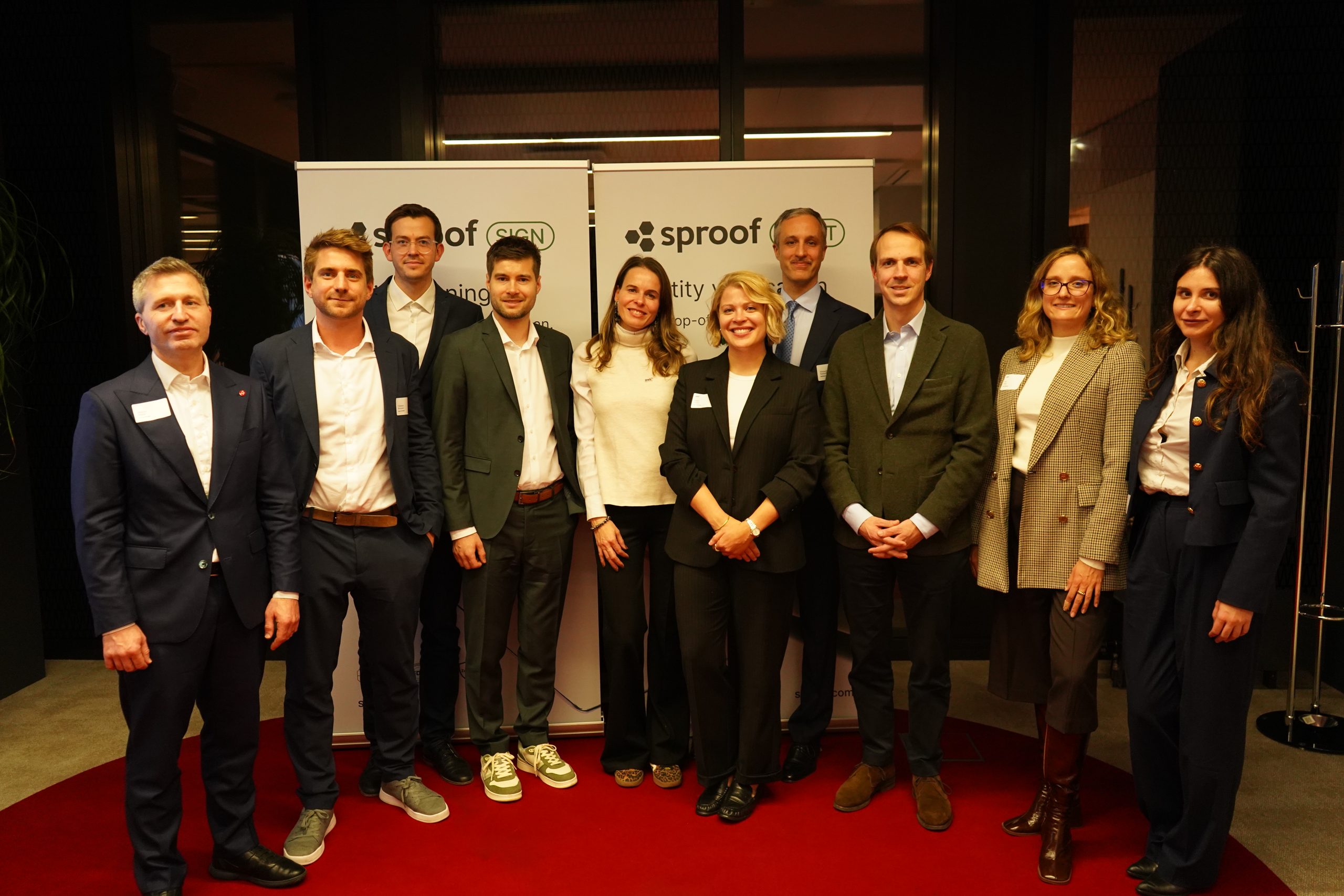
(from left to right: Dr. Markus Vesely, CEO, A-Trust; Dr. Clemens Brunner, CEO & Co-Founder, sproof; Philipp Gernerth, CPO, sproof; Dr. Fabian Knirsch, CEO & Co-Founder, sproof; Nina Stadler, Head of Corporate Communications & Marketing at PwC Austria; Isabel Kiener, Senior Associate, PwC Germany; Alexander Reithoffer, Product Owner for Digital Signatures/EUDI, Raiffeisen Digital; Clemens Müller, Tribe Lead for Corporates & Markets, Georg Labs; Siiri Nunn, Senior Associate, PwC Germany; Valeria Stefani, Senior Associate, PwC Austria)